Compression Fittings
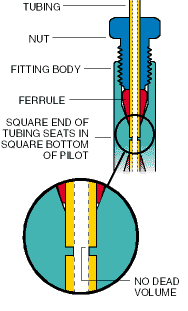
Compression fittings are special type of coupling, usually used to connect two pipes or a pipe to a fixture or valve. A compression fitting tightens down a sleeve or ferrule over a joint to prevent leakage. These pipe fittings are very strong and reliable and can be put on using just a pair of wrenches. These fittings do not require any heating and go well even with wet pipes.
Compression fittings are ideal for household plumbing applications.
 Materials
Used:
Materials
Used:
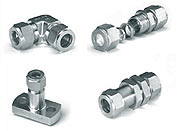
Compression fittings are usually made of materials like:
- Brass
- Plastic
- Copper
- Cast Iron
In cases, when compression fittings are used for joining pipes of two
dissimilar materials, for example PVC and copper, they should be made of
such appropriate materials that are perfect for the connection.
 Parts
of a Compression Fitting:
Parts
of a Compression Fitting:
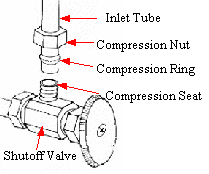
The pipe compression fittings consist of three parts:
- Compression nut
- Compression ring or inner ring or “olive”, and
- Compression seat
How it Works?
As the name suggests, compression fitting applies a compressive force
to the pipe and pipe fittings, thus forming a tight seal. In order to
prevent leakage of fluids, the fitting is compressed against the pipe
with a force that removes the presence of any space in between the
joints.
 Types of compression fittings:
There are two basic types of compression fitting:
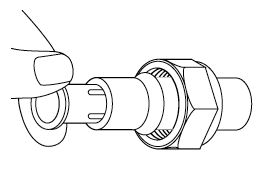
- Type-A or non-manipulative fitting: These fittings are
easy to install and do not require any modifications to the tubing.
Type-A compression fittings are also known as olive and can be
installed using an ordinary wrench for tightening the surrounding
nut. These fittings are usually used for water connections.
- Type-B or manipulative fittings: Installation of Type-B
fittings require flaring or belling the tubing. In order to remove
this type of fitting, a specialized pulling tool is often used for
siding the nut and olive away from the pipe or tube. The type-B
fitting is mostly used for gas lines.
Buying Tips
Factors to consider are as follows:
- The material used for making compression fittings is
extremely important for joining proper connection of pipes and
fittings.
- Size of the fitting is also important and the right size
should be chosen for right application.
Common Uses:
Compression fittings are globally used for plumbing applications for
joining thin-walled pipes or two tubes together. These fittings are
widely used for hot and cold water faucets; and toilet stop valves.
Guidelines for using Compression Fittings:
- Compression fittings should always be used with permanent or
stationary
 connections. These fittings are designed in such a way
that they restrict the movement of the pipe away from the fitting.
connections. These fittings are designed in such a way
that they restrict the movement of the pipe away from the fitting.
- While installing compression fittings, care should be taken not
to over-tighten them. Special care should be taken while using
plastic pipes. Because there is a point beyond which tightening a
compression nut will no longer yield any gain.
- When plastic pipes are joined through a compression fitting, a
plastic compression ring should always be used instead of a metal
ring.
- Compression fittings should not be used with bent tubes or pipes.
The points mentioned below will be a guide for the buyers:
