Rigid Coupling
Rigid couplings are used to connect rotating members such as shafts. They are compact, economical components for the timing, joining or aligning of shafts and provide transmission of torque and motion. They are used at lower speeds, particularly where zero backlash is desired. These type of couplings do not allow for angular or parallel misalignment. Rigid couplings are also not intended for use as a critical part of a drive line or as a substitute for flexible or universal joints. They are also not meant for other power transmission devices. They are basically used for aligned shafts only. They are the most cost-effective coupling option suitable for all rigid shaft connections.
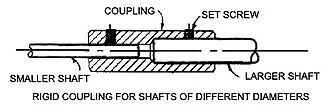
These
couplings comprise simple hollow cylinders having internal diameters of
the proper size which can fit over the shaft ends being joined. The
length of the coupling depends on the desired shaft gap between ends.
For light applications, setscrews are used to attach the shafts to the
coupling. This type of coupling do not accommodate for misalignment.
Materials used in Rigid couplings:
Some common materials used in making rigid couplings are as follows:
- Brass
- Aluminum
- Cast Iron
- Stainless Steel
- Carbon Steel etc.
Buying Tips Selecting a rigid coupling involves many
different performance factors such as:
- Torque
- Shaft misalignment
- Stiffness
- Rpm
- Space requirements, and
- Others, that must all be satisfied for the rigid coupling to
work properly.
|
Types of rigid couplings:
There are two basic types of rigid couplings. They are as follows:
- Set-Screw Coupling: The rigid set-screw coupling is that
type of coupling which is secured to the shaft by a set-screw that
impinges upon the shaft.
- Clamping Coupling: Clamping couplings are available in
both one-piece and two-piece styles. One-piece clamping couplings
are available with four tangential screws. These screws when
tightened grip the shaft without marring it. The two-piece clamping
couplings are available with eight tangential screws (four on each
side). These types of couplings are assembled without removing other
components on the shaft.
Installation of rigid couplings:
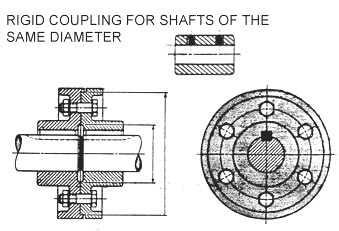
For all rigid couplings, the clamping screws are arranged in pairs. The
rigid couplings can be installed by tightening the paired screws
alternately. This can be done in several steps so that the tension is
distributed evenly.
When one screw is tensioned, it tends to relax any tension developed by
its paired screw. Hence, it is recommended not to tighten one screw
completely before tightening the other as this could lead to an unequal
distribution of tension. Again, when the screws are disassembled,
tension should be relieved in a similar manner.
Features of Rigid couplings:
To ensure proper performance in any kind of motion control
applications, several features of rigid couplings are required. They are
as follows:
- Rated torque: The maximum service torque for which the
product is rated.
- Rated speed: This is the maximum rated rotational speed
of the rigid coupling.
- Stiffness: This is expressed in degrees (torque per units
of angular deformation).
- Backlash: Due to a change, the rotational position loss
is measured in degrees.
- Honing: This corrects any residual distortions caused by
stresses occurred during the manufacturing process, resulting in a
round, precisely sized bore.
- Important dimensions
- Bore diameter: Internal diameter (ID) for mating to
the shaft-end.
- Coupling diameter: Outside diameter (OD), which
includes the housing.
- Design units are in inches (in) or metric
measurements such as centimeters (cm).
- Keyway width: This is an additional consideration for
rigid couplings with one or more keyways.
Styles of rigid couplings:
There are various styles available in rigid couplings. They are as
shown in the table below:

Set screw rigid coupling: The most common and simplest
style of rigid couplings is those with set screws to fix the
coupling to the shaft through impingement.
|

One-piece clamp coupling: One-piece clamp couplings are
solid. As a rule, one-piece rigid couplings can be used for
applications up to 3000 rpm.
|
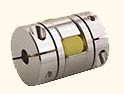
Clamp style rigid coupling: Another option is the
clamp-style rigid couplings. These couplings wrap around the shaft
to provide high torsional holding power without damaging the shaft
and fretting inherent in set screw types.
|
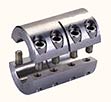
Two piece rigid coupling: There are two-piece styles rigid
couplings which have the additional benefits of allowing for
disassembly and maintenance without removal of other components.
When a two-piece style is used, couplings can be used for
applications up to 4000 rpm.
|
|
Multi-screw rigid coupling: Multi-screw rigid couplings
are also available. Here, all of the screws are inserted from the
same direction.
|
|
Shrink discs rigid coupling: Shrink discs rigid couplings
are available with two external rings that tighten together axially
and exert inward force on a third ring. This closes the inner ring
onto the shafts which in turn provide a secure connection.
|
|
Key ways rigid coupling: They include keys that can be
used to stop the rotation of the shaft couplings.
|
Conclusion:
Innovation in rigid couplings continues. Driven by customer needs, the
future should bring new products that are more stronger, lighter,
better, and more economical. By design, they still remain inflexible.
Benefits of rigid coupling:
The benefits of rigid couplings are as follows:
- They are economical.
- They have high torque capacity.
- They have torsional stiffness.
- They have zero-backlash.
- Rigid couplings with honed bores and other features to assure
proper performance are increasingly used in motion control
applications where components are properly aligned.
- In addition to motion control applications, they are also used to
connect line shafting or other components such as a motor to a
gearbox.
- Since rigid couplings cannot accommodate misalignment, they are
not recommended for use on mechanically fixed shafts. However, rigid
couplings are ideal for overhung and extended loads like pumps,
mixer paddles or long, unsupported shafts.
The points mentioned below will be a guide for the buyers:
